 Cres Ian Lorenzo

WHY is ube trending as the next matcha?
“The hype around the ingredient is largely driven by a global appetite for more exotic drink and dessert flavors, as food chains aim to replicate the success of Japanese matcha and Dubai chocolate, both of which were adapted into everything from cakes to milkshakes,” said an April 27 article on US business news website cnbc.com.
At the recent Thaifex-Anuga Asia 2026 food and beverage trade exhibition held at the Impact complex in Muang Thong Thani, Thailand, one of the crowd-drawers at the Philippine pavilion was the “100% Pure Ube” stall of Astoria Hotels and Resorts.
Thaifex-Anuga Asia gathered more than 3,000 exhibitors from 56 countries that showcased emerging food technologies and innovative products.
“Ube is a root vegetable that allows us to come up with different products while retaining its purple color. It can be diversified … I’ve even tried ube sinigang,” said Nick Anderson, Astoria corporate executive chef.
Purple yam (scientific name Dioscoreo alata), commonly known as ube, is a starchy, tuberous root crop native to Southeast Asia. It has been cultivated for centuries in the Philippines and widely used in traditional desserts such as ube halaya, halo-halo, cakes, pastries, and ice cream.
“Starbucks [in the United States] helped spark the trend in 2025 with limited-time offerings of Ube Iced Coconut Latte and Ube Espresso Martini, expanding its 2026 spring lineup to include an Ube Matcha Latte and Ube Vanilla Macchiato. US coffee chain Peet’s also introduced an Iced Vanilla Latte with Ube Dream Top for the season,” said cnbc.com.
F&B analytics firm Datassential, which has been tracking down ube’s popularity since 2017, said “ube offerings have risen by 230 percent across restaurant menus in the US in the past four years. It currently features on the menu at 95 chains across the US, and is predicted to grow 74 percent in the next four years.”
In 2025, the Philippines exported $3.2 million worth of ube — nearly 1.7 million kilograms — or a 20-percent increase from the previous year, according to data from the Philippine Statistics Authority (PSA).
“The US was the largest importer, accounting for $1.6 million, or half of total exports. Canada, Australia, and the United Kingdom were the next largest markets,” said cnbc.com.
However, the Philippines can’t meet the demand.
Ube farmers face mounting production challenges: declining yields, small-scale farming, and limited resources, according to the Philippine Root Crop Research and Training Center (PhilRootcrops), which is based at Visayas State University (VSU) in Baybay City, Leyte.
PhilRootCrops explained that the crop demands specific soil and environmental conditions, requiring careful site selection. High-quality, disease-resistant planting material remains scarce, contributing to a drop in production volume from 30,074 metric tons (MT) in 2006 to only 14,000 in 2020.
Total output was down 1.63 percent from 13,381 MT in 2024 to 12,483 in 2025, according to PSA data.
Labor-intensive cultivation and insufficient mechanization further limit output. Seasonal supply can’t even meet nationwide demand, and the Philippines’ exposure to frequent typhoons — like 2022’s Typhoon Odette — regularly devastates harvests, threatening Bohol, the country’s “ube capital.”
Ube from Zambales
On a smaller but considerable scale, the Astoria Culinary Expert Services (ACES), the corporate catering and food solutions arm of The Astoria Group, has been buying various crops from its farmer-partners in Central Luzon, including ube from the Aetas in Zambales.
Astoria had observed that many ube products use artificial flavors, and real ube is only seasonally available from October to February.
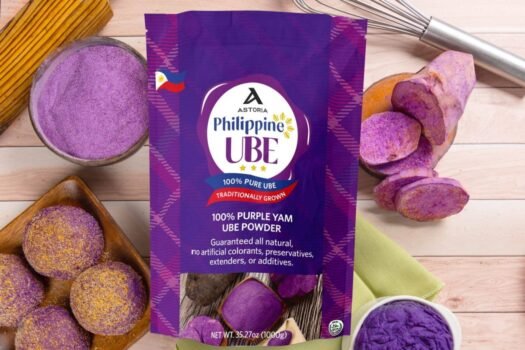
As a solution, Astoria developed a 100-percent pure Philippine ube powder — no additives, colorants, or preservatives — using locally-sourced ube. Created with chefs, agricultural specialists, and food scientists, the shelf-stable powder lasts over a year, making authentic ube available year-round for home and professional kitchens alike.
These products — which are served to Astoria hotel guests and clients, as well as at the employees’ cafeteria — are bought at a fair price to benefit the farmers.
“Before, middlemen were exploiting the Aetas. Astoria went directly to the Aetas. [We also] helped them with sanitation and the schooling of their children. So, it’s not all about profit,” Anderson said.
He and the Astoria team gladly answered questions and inquiries at Thaifex. The inquiries the received show growing interest in Philippine-grown ube.