 Cres Ian Lorenzo
LOS BAÑOS, Philippines — Cutting methane emissions from rice fields is possible. But what does it do to the soil that farmers depend on for the next planting?
That is the question now being asked by the International Rice Research Institute (IRRI), based here, as it starts the second phase of its joint research with German agricultural company BASF.
IRRI and BASF formally launched on Oct. 1, 2026 Phase 2 of Optima, short for Optimizing Management for Reduction of GHG in Rice, according to IRRI.
Optima Phase 1, IRRI said, showed that three practices combined — direct-seeded rice instead of transplanted, better fertilizer management, and alternate wetting and drying (AWD) — can reduce water use and methane emissions without lowering yield. Under AWD, a rice field is left dry for a few days in between flooding, instead of keeping it flooded all season.
IRRI also tested its computer model for rice growth, called Otyza — named after Oryza sativa, the scientific name for rice — and found it can track how water moves in the field and predict how much methane will be released. IRRI said this makes the model useful for counting greenhouse gas (GHG) reductions and for future carbon farming programs.
Looking deeper into the issue
Phase 2, IRRI said, looks deeper into the issue.
IRRI explained that soil organic carbon — the organic matter that makes soil fertile — changes depending on how often farmers plant, how they manage rice straw, and whether they add organic materials.
When a flooded field is dried, soil microbes get oxygen and become more active. They break down organic matter faster and release carbon dioxide. Over many seasons, IRRI noted, this could mean soil carbon built up over years might slowly be lost.

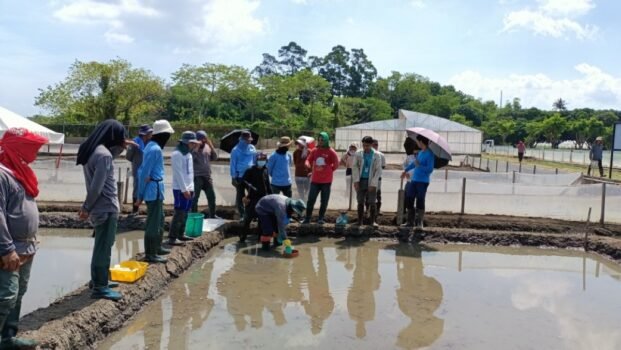
IRRI and BASF have launched the second phase of a project to advance low-emission rice technologies including direct-seeded rice, improved nutrient management, and alternate wetting and drying. IRRI PHOTO
That trade-off matters, IRRI said, because methane reduction can be seen quickly, but soil carbon loss is slow and hard to notice — yet it affects fertility and long-term harvests.
“Optima 1 has established that the Oryza model is a useful tool to quantify climate benefits of AWD. Our next step is to understand what its effect is in the long term on the system’s long-term sustainability, particularly for soil health and soil carbon dynamics,” said Ligia Bacchereti Azevedo, Senior Sustainability Manager for Agricultural Solutions of BASF, during the kickoff meeting for the joint initiative.
“Optima 2 will help us examine whether low emissions practices can support long-term sustainability, while considering potential trade-offs,” the BASF official said.
IRRI said the new two-year study will compare different ways of doing AWD and see how straw management and biochar — charcoal-like material added to soil — interact with it to affect yield and carbon storage.
The institute said it will also improve the Oryza model so it can simulate these effects over the short, medium, and long term. To do this, IRRI will use data from its Long-Term Continuous Cropping Experiment in Los Baños, one of Asia’s longest-running rice experiments that has tracked soil changes for decades.
“The continuation of this partnership is a testimony of the alignment of BASF and IRRI vision in ensuring transformation of rice systems towards low-emissions systems are supported by science-based evidence and farmers will be equipped with the best combinations of technologies optimized for productivity, profitability and sustainability,” said Virender Kumar, Research Director of IRRI’s Sustainable Impact through Rice-based Systems Department.
IRRI said Optima 2 starts this wet season of 2026. The goal, according to IRRI, is to give clearer, field-based evidence on how to lower GHG emissions, especially methane, without harming the soil that sustains rice farming — so that low-emission practices can be promoted at scale with confidence for both climate and farmers.