 Cres Ian Lorenzo
PURPLE yam, largely grown as a backyard crop and seasonal ingredient in Region 2 (Cagayan Valley), is being developed as a primary commodity under the High Value Crops Development Program (HVCDP) of the Department of Agriculture Regional Field Office 2 (DA-RFO2).
Ferdinand Cortez of the DA-RFO2 Regional Agriculture and Fisheries Information Section said the shift is being pursued through coordinated work among the agency’s research centers and experiment stations, which are consolidating production technologies and market linkages to expand ube cultivation to a commercial scale.
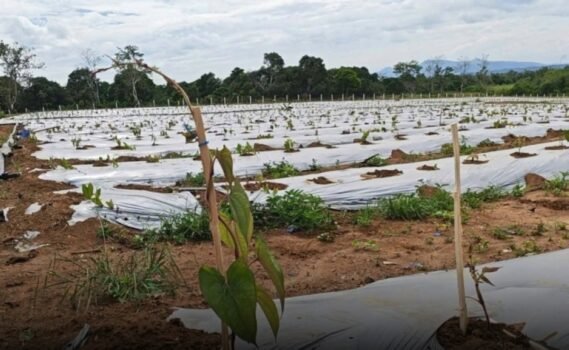
Cortez said a 100-hectare plantation in Echague, Isabela serves as one of the focal areas for the program.
The initiative is driven by rising domestic and export demand, and the need to diversify cropping systems in the region, which has traditionally been associated with rice and corn.
Farmers previously faced constraints that limited ube as a large-scale crop, including seasonality, susceptibility to pests and diseases such as anthracnose, and uneven quality of planting materials.
Cortez said that the DA-RFO2, through its HVCDP and research centers, has introduced interventions to address these gaps.
Researchers are advancing tissue culture and mini-tuber production to provide disease-free, high-yielding plantlets aimed at reducing crop failure and improving uniformity.
The approach is intended to ensure a consistent supply of quality planting materials to growers.
The agency has also developed intercropping models that allow ube to be grown under light canopies or alongside existing seasonal crops.
The system is designed to optimize land use, maintain soil health and provide flexibility for smallholders facing variable weather conditions.
Alongside propagation and cropping systems, Cortez said that the DA-RFO2 has rolled out a standardized package of technology covering fertilization, trellising and post-harvest handling.
The package is being disseminated through training and production guides to improve yield and tuber quality, he added.
The push comes amid stronger demand for ube as a natural food colorant and as a base for traditional and modern food products such as ube halaya, ice cream, pastries, and other processed items.
“The surge in global and domestic demand for natural food coloring, traditional desserts (ube halaya, ice cream, pastries), and health-conscious food products has made ube one of the most profitable commodities per hectare in the high-value crop sector,” said Carol Pasion Albay of the Regional HVC Philippines and Export.
Albay said ube commands higher pricing compared with staple crops with narrower margins.

Purple ube thrives across a 100-hectare plantation in Echague, Isabela. DA PHOTO
Varieties propagated at its research centers are selected for high dry-matter content and deep purple pigmentation, traits sought by food processors and commercial bakeries.
Beyond raw tuber sales, the regional office is working with farmers’ cooperatives to promote value addition, including processing into powder, puree, and chips.
The move up the value chain is intended to allow farming communities to capture larger returns than those from unprocessed tubers.
The expansion also aims to address supply gaps previously encountered by food manufacturers during periods of national shortage, positioning Cagayan Valley as a key supplier for northern Luzon and Metro Manila.
Linking science to livelihoods
Cortez said the development of ube reflects a broader strategy of pairing research-based production systems with market linkages to support smallholder incomes.
He said that the continued refinement of propagation techniques and market-driven approaches is expected to strengthen regional supply chains and establish the Cagayan Valley region as a hub for high-value crops.
“What was once treated as an underutilized crop is being repositioned as a component of regional agricultural development, with the 100-hectare site in Echague serving as a model for scaling up production and integrating farmers into processing and marketing channels,” Cortez added.
If adoption widens, DA-RFO2 expects the commodity to contribute to more resilient farm systems and more stable income streams for participating households, while meeting growing commercial demand for purple yam-based products.