 Cres Ian Lorenzo
BATAC, Ilocos Norte — Improved technology for garlic cultivation in this province is being dispersed to other provinces gradually with the aim of improving the country’s production of the commodity.
The Mariano Marcos State University (MMSU) is delivering improved garlic production technology to Ilocos Sur and Occidental Mindoro, in a push to raise productivity, widen adoption of science-based practices, and strengthen the garlic industry beyond its traditional growing areas.
From Nov. 3 to 7, 2026, the university conducted another series of project visits in the two provinces, following earlier engagements in Nueva Vizcaya, Cagayan, and Ifugao, MMSU said.
The visits were conducted under the project “Scaling-out Improved Garlic Production through Integrated Crop Management for Garlic in Northern and Selected Expansion Areas.”
The initiative is funded by the Department of Science and Technology-Philippine Council for Agriculture, Aquatic and Natural Resources Research and Development (DOST-PCAARRD) and led by Dionisio Bucao, director of the MMSU Research Directorate.
Integrated crop management
Integrated crop management brings together the practices that affect garlic yield in one system, MMSU said. It covers the use of quality planting materials, proper land preparation and planting, nutrient and water management, pest and disease control, and timely harvest and postharvest handling.
The project team, composed of Evangeline Galacgac, Carlo Bumagat, and Janzen Lyle Hingpit from MMSU engaged local government units, state universities and colleges, and farmer cooperatives as the state university dispersed improved farming technology for garlic.
In Occidental Mindoro, the team went to Palauan, Mamburao, Santa Cruz, and San Jose, and to the Occidental Mindoro State University. In Ilocos Sur, the team engaged the Ilocos Sur Polytechnic State College.
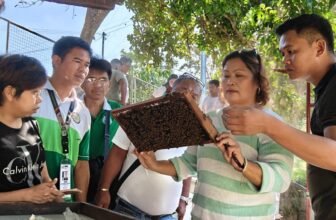
Activities included courtesy calls and dialogue with municipal agricultural offices, coordination meetings with local partners and farmer-cooperators, and discussions on the project’s objectives, planned activities, expected outputs, and the roles of stakeholders.
Planting materials and other farm inputs were also distributed to support adoption of improved garlic production practices, MMSU said.
The initiative seeks to expand farmers’ access to science-based technologies, increase garlic productivity, and promote more sustainable farming practices, according to MMSU.
For the garlic industry, the wider spread carries a broader meaning. Local production remains limited to a few provinces and a short harvest season.
Expanding production to new areas, with better management, is seen by project implementers as one way to raise local output and give farmers an added income source.